

May 2012
After a muscle strain or minor injury our body goes through a period of recovery. Whether it is an ankle sprain or a hard fall on our backside we are left feeling a little stiff after the normal healing period. Inherently, we know that stretching is a basic part of recovery.
Traditional stretching exercises emphasize slow, prolonged positions where a muscle is lengthened and held there for a bout 30 seconds or so. This form of stretching continues to be valuable in recovery from a mild injury.
Just like any form of exercise, new trends in fitness and health emerge as alternatives to more traditional methods. Here are some different forms of stretching to consider:
· Dynamic Stretching: Slow movements that lengthen a muscle repeatedly without a prolonged hold.
· Static Stretching: A prolonged hold in a position that maximally lengthens a muscle. Usually held 30-90 seconds
· Ballistic Stretching: Fast movements that lengthen a muscle group to the point of strain. This form is NOT recommended as a safe way to stretch in most cases.
· Manual/Passive Stretching: A prolonged hold with the muscle lengthened fully but held by an outside force (i.e. a partner).
Although there are many ways of accomplishing flexibility goals it is suggested that any form of stretching that is used be specific to the activity. For example, a runner who stretches before there usual running is now encouraged to do a more dynamic stretching routine rather than static. Also, a dancer who needs extreme flexibility might need manual/passive stretching prior to performing.
One technique that can be extremely effective in promoting flexibility to a damaged or injured muscle is to use the “hold-relax” method. This method uses a combination of passive and active stretching.
In the “hold-relax” method the muscle is passively lengthened first, then GENTLE resistance is added (usually by a partner) without allowing any movement. This usually helps to make the stretch more comfortable and increase the range of motion.
Your Physical Therapist can perform “hold-relax” stretching to relieve pain and stiffness in many parts of the body. So let us help you get back in motion again!

A throwing motion or overhand racquet serve is a complex movement. In sport, an athlete is usually throwing or hitting for velocity and accuracy. The complicated pattern of movement required for a strong and accurate overhand involves the upper extremity, the trunk and the lower extremities. To maximize the distance and velocity of the throw your hips and trunk must work together in an efficient manner.
A recent study in the American Journal of Sports Medicine (Oct. 2009) has examined the difference in hip characteristics between professional baseball pitchers and other position players. They found that pitchers have greater hip abduction strength and less hip internal rotation range of motion than other position players. The specific throwing pattern of baseball pitchers requires their outer hip muscles to be strong and this study Control is what forms the foundation for arm swing and a high speed underhand throw. It is the explosion of the hip in the push-off phase of an underhand throw which gives it a consistent high speed.
Just as in throwing a ball, an overhead motion with a racquet produces similar demands on your lower body. For a strong tennis serve or racquetball smash you must use your hips to stabilize your lower trunk while completing the movement. Put some power in your overhand, strengthen those hips!

The “Rotator Cuff” is made up of 4 muscles in the shoulder that help stabilize the arm bone in the shoulder “socket”. This group of muscles is notorious for injury and subsequent surgery. Physical Therapists often treat rotator cuff injuries conservatively if surgery is not indicated. When surgery is needed, typically there are three different surgery techniques used: Open, mini-open and arthroscopic.
As the least invasive technique, arthroscopic repair of the rotator cuff is gaining acceptance since it is offers the least pain during the post-operative period, keeps the other existing muscles intact during the procedure and offers the smallest incision.
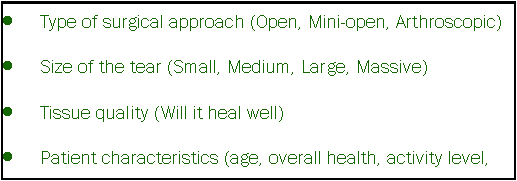
Rehabilitation following rotator cuff repair varies based on numerous factors. Among these factors here are some that are considered:
The primary goal of post-operative rehabilitation is to protect the repair, promote healing and to gradually restore function in the arm. Early movement of the shoulder is important to keep from developing stiffness. Although early movement is encouraged in all types of repair, different patient characteristics require different degrees of caution. After 6-8 weeks active movement and possibly light strengthening is begun, although it is still carefully monitored.
In summary, newer surgical techniques and more specific rehabilitation methods are leading to better outcomes for patients of all ages. If you are having rotator cuff surgery consider us for your rehabilitation needs.
[Reference: Ghodadra N.S. et al, Open, mini-open and all other arthroscopic rotator cuff repair surgery: Indications and implications for rehabilitation. JOSPT. 39(2): 81-89; Feb.